
The National Museum of Ireland Decorative Arts & History Museum is housed in the historic Collins Barracks in Dublin, and it’s one of those places that surprises families every time they visit. Between the soaring galleries and quiet courtyards, there are treasures tucked away that most visitors walk straight past.
Here are 10 unexpected treasures and experiences to discover at NMI Decorative Arts & History Museum, and where to find each one.
The National Museum of Ireland runs events for kids and families throughout the year, many of them free to attend. It’s worth checking the current events listing before your visit to see what’s on.
10 Unexpected Treasures & Experiences to Discover at National Museum of Ireland Decorative Arts & History Museum
#1. The Asgard

Asgard is a 51-foot (16m) yacht that was owned by the English-born writer and Irish nationalist Erskine Childers and his wife, Molly Childers.
It served during the First World War and has an amazing story to tell about the part it played in the Howth gun-running incident of 1904.
Where: Gallery 29 – Asgard
#2. Vampire Jet

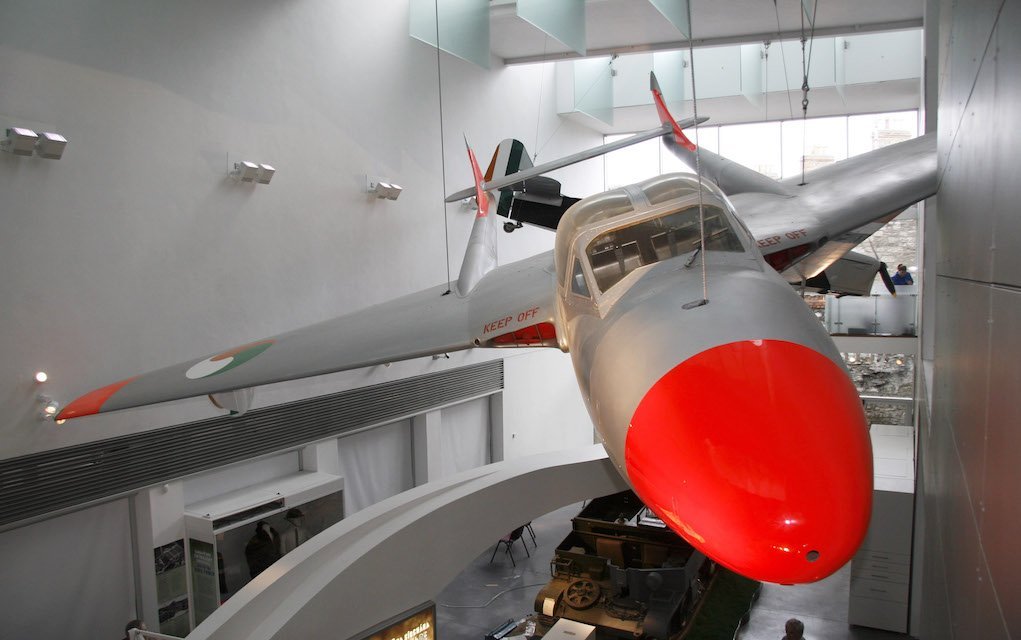
While wandering around the Soldiers & Chiefs exhibit, look up: the jet suspended from the roof will surprise you! It’s a De Havilland Vampire jet in Irish Air Corps colours.
Here you’ll also learn how Ireland changed from a country supplying foot soldiers for the British Army to an independent nation with its own armed forces.
Where: Gallery 22/23 – Defending The Peace, Soldiers & Chiefs
#3. The Stokes Tapestry

Stephen Stokes was a British soldier stationed in Ireland. He created this tapestry to represent the story of his career.
Can you imagine spending 15 years on a single piece of work? That’s how long it took him.
Where: Gallery 15 – The British Garrison in Ireland, Soldiers & Chiefs
#4. Astrolabe

Long before GPS – or even telescopes – existed, astronomers and explorers used the astrolabe to read the skies and navigate the seas.
You can see an example of this unusual navigation instrument in Gallery 1. This astrolabe was designed by Jacob Habermal of Prague and is made of copper gilt.
Where: Gallery 1 – Curator’s Choice
#5. Samurai Armour

Samurai armour was worn in Japan during the 17th and 18th centuries by soldiers and bodyguards who lived by a strict code – The Way of the Warrior.
The Samurai went on to become rulers of Japan during the 18th century and were the only people allowed to carry swords. They dressed in a distinctive way and were instantly recognisable as a result. The armour on display is a replica from the era when Japanese and Chinese art became fashionable throughout Europe.
Can you count the number of parts that make up the samurai armour? There are 23 of them!
Where: Gallery 2 – Out of Storage
#6. 17th Century Bedroom

Have a look at the 17th century bedroom and compare it with your own! Beds were the most valuable pieces of furniture in Irish houses during the 17th century, and were even a symbol of power.
Beds were surrounded by decorative curtains at this time, and later, upholstered canopy beds became fashionable – these were known as tasters.
In some noble houses, certain servants had their own bedchambers. Others slept in the same room as their masters, in a truckle or wheel bed stored under the main bed. Menial servants slept in the attic, while farmers and merchants had small bedchambers of their own. In the great houses, bedrooms were of a semi-public nature.
Where: Gallery 6 – Four Centuries of Furniture
#7. Thangkas

There are 12 Thangkas on display at the museum, part of a wider collection of 21 that illustrate the Arhats (disciples) of Buddha, and the four guardians of the four quarters of the world.
Thangkas serve several functions in Tibetan Buddhism. They’re used as teaching tools, act as a central focus during rituals or ceremonies, and serve as a medium through which prayers and requests are offered to the divine.
Try making a list of all the hidden animals you can spot!
Where: Gallery 13a – A Dubliner’s Collection of Asian Art: The Albert Bender Exhibition
#8. Children’s Clothing

Clothes have changed enormously over the centuries. Take a look at how your great-grandparents were dressed and compare it to what kids wear today!
You can also see some toys on display that are more than 100 years old.
Where: Gallery 12 – The Way We Wore – 250 Years of Irish Clothing & Jewellery
#9. The Barracks Life Room

Ever wondered what life as a soldier was really like in the past? Where they lived, what weapons they used, and what they wore?
To see how a barracks room would have looked in 1879 and 1943, make your way to the interactive Barracks Life Room, where you can also try on costumes and handle military hardware.
This is a great hands-on activity for families or groups to enjoy together.
Where: The Barracks Life Room
#10. Clarke Square

Finally, be sure to visit Clarke Square. This courtyard is the heart of Collins Barracks, and the heart of the National Museum of Ireland – Decorative Arts & History. It’s named after Thomas Clarke, one of the seven signatories of the 1916 Proclamation of the Irish Republic, who was executed that same year.
Where: Clarke Square, Central Courtyard
Frequently Asked Questions
Where is the NMI Decorative Arts & History Museum located?
It’s based at Collins Barracks, Benburb Street, Dublin – one of the National Museum of Ireland’s four sites.
Is the museum a good day out for children?
Yes. Alongside the galleries, there are interactive spaces like the Barracks Life Room where kids can try on costumes and handle replica military gear, plus plenty of visually striking exhibits – like the suspended Vampire jet – that capture children’s imagination.
Is there an admission fee?
National Museum of Ireland sites have traditionally offered free general admission, though it’s worth checking the museum’s website for current opening hours and any details before you travel.
How long should we plan for a visit?
This depends on how much ground you want to cover and the ages of your children. Families often find a couple of hours is enough to enjoy the highlights, but check the museum’s current opening hours before planning your visit.
Related Articles
Looking for more family days out in Dublin? You might also enjoy our guides to free museums and galleries for families, top indoor activities for rainy days, and other hidden gems to explore with kids across Ireland.
Save This for Your Next Family Day Out
Bookmark this list before your visit so you don’t miss any of these unexpected treasures on the day. It’s easy to walk past a gallery without realising what’s inside!
Want More Family Day Out Ideas?
Sign up for our weekly newsletter for fresh ideas on things to do with the kids, from museum visits and outdoor adventures to rainy-day activities near you.